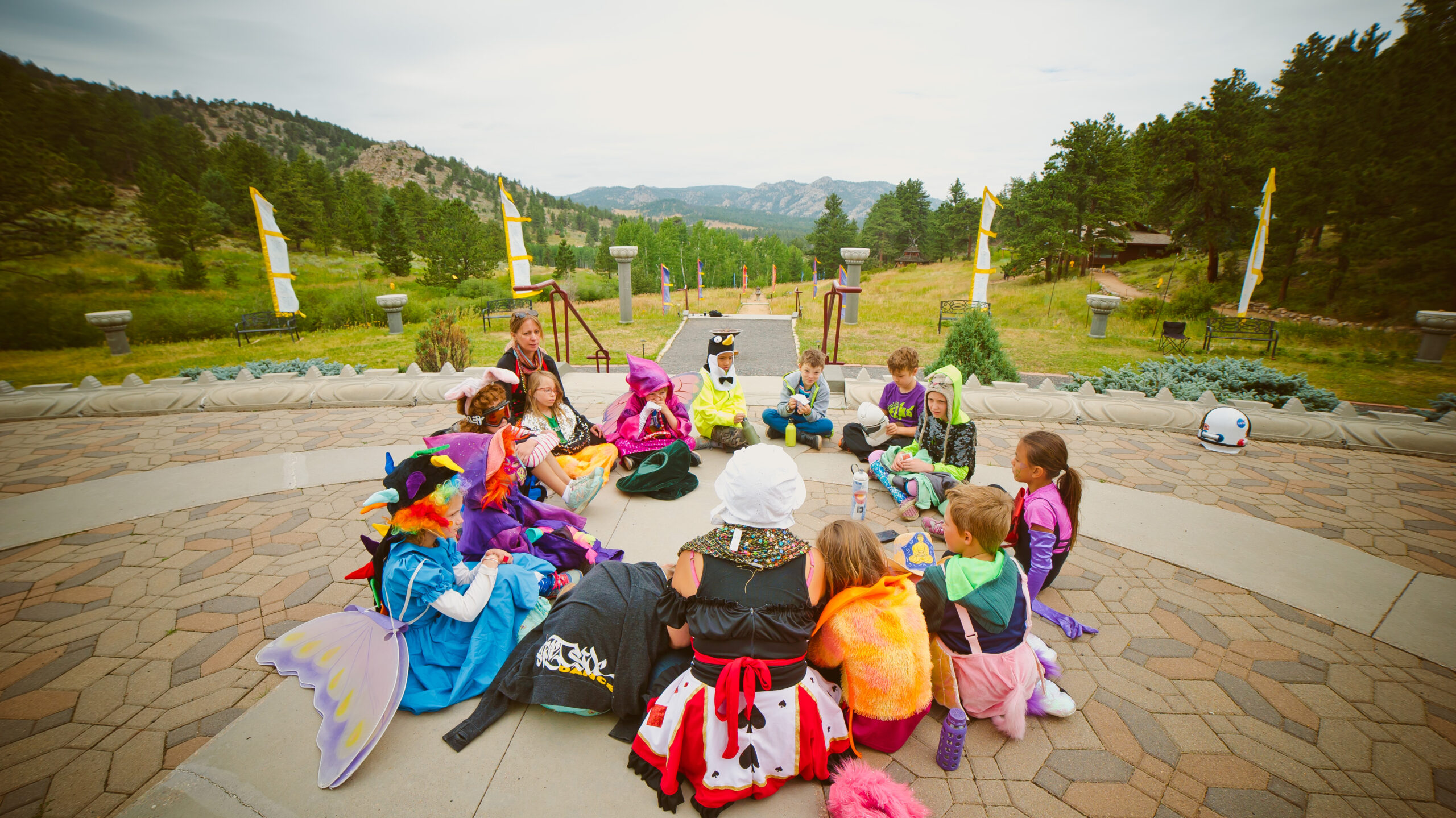
Seeing Children and Family Life through the Eyes of Goodness
By Leslie Gossett //
Have you ever noticed how often humans operate from the premise of there being a problem? Whatever is happening, it is not the right thing. There is something to be fixed. The coffee isn’t strong enough. The temperature is too hot. It’s too cold. We are hungry. We are stuffed. We are tired. We don’t want to go to bed. It’s completely endless. We even take this extreme into how we relate to other people. We begin to view them through the eyes of wanting them to be different. We want them to look differently, feel differently, and act differently. This desire can be subtle. And usually it happens most toward those closest to us, especially our children.
Children are constantly and exhaustingly bombarded with admonitions of, “stop that,” “sit still,” “be quiet,” “we don’t say that,” “you can’t do that here,” “stop crying,” “stop running,” “don’t put that there,” “act like a big girl,” “don’t be a baby,” and the list could go on. Adults are not exempt from such commands. We are living in a world which puts constant pressure on us to be different from how we are. The premise being that there is something to fix. The premise being that we are not worthy, not good enough.
Living against this stream of aggression can invite anxiety, depression, stress, and a lack of contentment with oneself and one’s experiences. So what can we do? We can learn to look at each other (and ourselves) through the eyes of goodness. This means we learn to see things as fundamentally okay, right from the start. Even when something needs to change, we can view it as “not a problem.” How do we learn to take this approach?
First, we have to relax. Take a few deep breaths. Go outside. Take a day off. When we invite space into our world, however that looks, we feel better and can see more clearly. Space holds everything—good and bad—without discriminating. Think of the light of the sun—it doesn’t only shine on certain things, and refuse to shine on others. There is no problem. It shines on all.
Once we relax, then we have to feel. We feel our hearts. We feel our feelings. We listen to what our mind and body are telling us. There is fundamentally no problem in our being. We are okay on a very basic level. Our human experience is a worthy one.
After feeling comes the letting go. We must relinquish our agendas for wanting to control everything. We must meet things as they are, without resistance. We must meet ourselves as we are. That’s the only working basis of anything—because it’s the only reality. We can pretend like we can control our environment, or other people. But really all we can do is meet them as they are. Letting go means surrendering to the natural flow of our world. Dancing with what comes. And not being too attached to outcomes.
So how does this play out in our relationships? Well, when we trust ourselves and our own okayness, we relax enough to show up with other people. Take our children for example. We can be present to them and available. We aren’t just on our iPhones while they play. We are acknowledging them, making eye contact, and communicating. This allows us to feel what is happening. We notice that they are joyful or sad (or when we are). We know when they need help or something else from us. And because we are connected to what is happening without trying to control it, we actually know how best to help. We let go of expecting our children and ourselves to be a certain way. All the stories about how they should know better, or how they are too old for this, or how we are too busy fade away. All that’s left is how we arise in the present moment, without agenda.
When we can relate like this, we experience genuine connection. We deepen our capacity for love and compassion, and stress and hesitation diminish. When we live into the beauty and okayness of things as they are, and people as they are, our relationships to self and other become nourishing and vibrant.
This can be especially poignant amidst the busy chaos of family life with young children and teens. Because our biological response to stress and exhaustion is aggression, it’s easy to get caught in the struggle of not being able to look at each other through the eyes of goodness.
Taking time together, away from the stress, in the natural world to practice being together is so important. However you can do this, make it a priority. Look with the eyes of goodness!
Join us for Spring Break Family Retreat with Leslie Gossett and Kate Raddock, March 26–30, 2018 — click here to learn more >>
More by Leslie Gossett
About the Author
 Leslie Gossett is the Director of Family and Children’s Programming for Northern California Shambhala and founder of Be You Yoga and Mindfulness for Families and Children. She has worked with children for over 19 years. She is a certified yoga teacher for children and adults, a Meditation Guide in the Shambhala tradition, and a nanny to four amazing beings. She is dedicated to creating spaces for humans (and especially small ones) to connect with the strength and wisdom of their own hearts. She lives and works in the San Francisco Bay Area.
Featured image by Leslie Gossett