The Buddha Turns the Wheel of Dharma
By Acharya Judith Simmer-Brown
(Excerpted from Article in Bodhi Magazine, October 2002)
After the awakening, a radiant Buddha remained seated under the Bodhi tree for seven weeks, enjoying the bliss of emancipation. According to legend, the Indian god Brahma was concerned that he would pass into oblivion and appeared to the Buddha, supplicating him to teach what he had discovered. But the young Shakyamuni hesitated; the truth that he had found was “deep, difficult to see, difficult to understand.” How could he possibly communicate his insight into the nature of reality in a way that could be helpful to others? The divine Brahma continued his request; if the Awakened One did not attempt to teach others the way to awakening, the entire world would be left in the grip of despair and torment. How could the awakening be complete without the Buddha’s compassion?
Moved by the supplication of the great god, Shakyamuni resolved to share his experience with others and to lead them to awakening. Remembering five companions with whom he had practiced austerities, Shakyamuni arose from his seat and set out to find them. He journeyed one-hundred thirty miles west to Sarnath—“deer park”—a hermitage outside the city of Varanasi. When the five yogins noticed his approach, they grumbled, still deeply disappointed with his abandoning the path of asceticism, saying, “Here comes the ascetic Gautama, that slacker, that greedy one, that fallen one. None of us must go to meet him nor rise before him nor help him with his robe and his begging bowl. Let’s just ignore him.”
Nonetheless as Shakyamuni approached their hermitage, the five were stunned by his radiant appearance, his noble carriage, his confidence and magnetism, and they had no choice but to spontaneously arise respectfully. One stepped forward to take his robe and begging bowl, another brought a seat, and another brought water to bathe his feet. Together they greeted him warmly, welcoming him, and reverently asked about the radiant glow of his complexion, his serene demeanor, the certainty in his eyes. And he then proclaimed, he was now awakened, Buddha, completely beyond fear and torment. If only they would receive his guidance, they also could become free. Under a moonlit night they sat together in the hermitage grove, and the Awakened One reversed the cosmos with his teachings.
The events that night are said to have been so monumental that the ineluctible pattern of suffering and confusion was reversed forever. The prevalent Indian symbol for the progression of events was the wheel, turning in a pattern of cosmic predictability. Beings are born, they die, and then are reborn, re-enacting an ancient pattern of karma. According to the prevailing traditions, the only escape from the repetitive cycles of the wheel was to see the entire progression as illusory display and to discover the hidden, unborn self. The Buddha presented a different option that night, and called his teaching the “setting into motion the wheel of truth”—the inauguration of a completely new way of life which saw the true nature of reality resorting neither to indulgence nor asceticism.
The short teaching of that moonlit night is the most famous in the entire Buddhist world, the Dharma-cakra-pravartana-sutra, or “discourse that set into motion the wheel of truth.” In this discourse, Shakyamuni outlined the middle path between the extremes of asceticism and self-indulgence, and the teachings that came to be known as the Four Noble Truths: the truth of suffering, the truth of the conditionality of suffering, the truth of the cessation of suffering, and the truth of the path which leads to the cessation of suffering. This approach embraced mindfulness and awareness, rejected craving and ego-clinging, and promised the end of confusion and suffering without indifference or detachment. These were the teachings which founded the Buddhist tradition.
Join Judith Simmer-Brown for this upcoming program:

About the Author
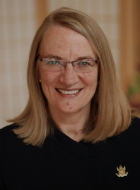 Acharya Judith Simmer-Brown, Ph.D., has just retired as Distinguished Professor of Contemplative and Religious Studies at Naropa University in Boulder, Colorado, where she has taught since 1978. As Buddhist practitioner since the early 1970’s, she became a student of Chogyam Trungpa Rinpoche in 1974, and was empowered as an acharya (senior teacher) by Sakyong Mipham Rinpoche in 2000. Her teaching specialties are meditation practice, Shambhala teachings, Buddhist philosophy, tantric Buddhism, and contemplative higher education. Her book, Dakini’s Warm Breath (Shambhala 2001), explores the feminine principle as it reveals itself in meditation practice and everyday life for women and men. She has also edited Meditation and the Classroom: Contemplative Pedagogy for Religious Studies (SUNY 2011). She and her husband, Richard, have two adult children and three grandchildren.