In the Times of Coronavirus: How to Be Informed Without Being Overwhelmed

By Megan Prager
Is it possible in this time to stay informed and not be totally overwhelmed?
Like many, I find myself consuming a large amount of media. There are beautiful stories of people supporting one another, as well as many stories and statistics of suffering that can leave us in wonder and fear. Recently the World Health Organization put out a list of Considerations to Support Mental Health in the times of COVID-19, with one recommendation being:
Minimize watching, reading or listening to news about COVID-19 that causes you to feel anxious or distressed… seek information updates at specific times during the day, once or twice. The sudden and near-constant stream of news reports about an outbreak can cause anyone to feel worried.
Important advice indeed. When we aren’t intentional about consuming news related to COVID-19 both in terms of content and amount, we can easily experience feelings of distress and overwhelm.
Here is the thing about overwhelm:
- It doesn’t feel good! We suffer when we feel it.
- What we know about optimal adult learning (based off the work of Psychologist Lev Vygotsky) is that we learn best when we step outside our safety zone- but not too far out!
If we are overwhelmed, we are flooded with emotion. Emotions that can cause us overwhelm can impair our prefrontal cortex which is the part of the brain that helps us make skillful decisions. So many of us are making large and small decisions right now- this part of the brain can really help us!
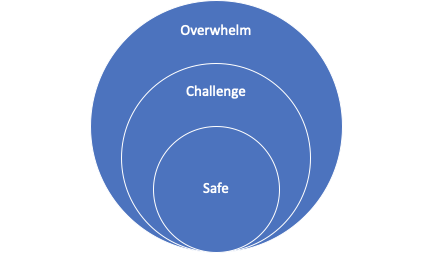
A practice in the Mindful Self-Compassion program that I am finding particularly helpful at this time in being intentional about my news consumption so that I stay informed without being overwhelmed, is to check in with myself using the Three Learning Zone Circles (see image above).
Before checking the news next, try this out. Ask yourself, “Which circle am I in?” The answer will help you determine whether it’s useful to engage in COVID-19 updates or not. Here’s how to know:
Overwhelmed?: Though different for everyone, some signs of overwhelm could be:
- Feeling flooded with emotion, often challenging emotions
- Body posture is tense/tight, (maybe even body aches or pain)
- The mind may be racing and/or thoughts may be fear-based or reactionary
When we become overwhelmed- and let’s face it we all do from time to time- we must go all the way back to safety and hang out here until our physiology recovers. We cannot go from Overwhelm to Challenge. Safety is the foundation for learning. Then, the amygdala calms and the prefrontal cortex comes back on line. In other words, coming back to safety actually resets the brain’s ability to learn. Read more about how to find safety below.
*Consideration: It’s worth noting that this is a time when many of us are experiencing overwhelm. This is why it’s so important to be extra diligent about self-care. And if you are noticing frequent or constant overwhelm, connecting with a healthcare professional can really help (Nami is a great resource for those not already connected).
Challenged?: This circle is where we learn the most. Signs of challenge include:
- Being engaged and receptive to learning
- The ability to actively integrate what you are learning into daily life
- Posture is alert rather than rigidly tense
- Mind is more open, and open to possibility rather than constricted
*Consideration: It’s helpful to notice where you are in the challenge circle- closer to safe or overwhelm? If close or moving towards overwhelm, it is skillful to move back to safety. We don’t have to ride the edge of overwhelm to learn and grow. Can you take a more self-compassionate stance and stay solidly in the challenge circle, with a bit of a buffer between challenge and overwhelm?
Safety?: When in this circle, there is a sense of comfort, calmness and ease in the body and mind. Safety has that feeling/sound of a deep exhalation, “Ahhhhhhh.” While holding back from engaging sometimes happens here, keep in mind this circle is the foundation of learning, and it’s really helpful to know how to move to this circle.
*Consideration: Not sure of how to create safety? Try taking care of yourself in a way that creates a sense of well-being (having a warm cup of tea, feeling the soles of your feet ground you, connecting with a friend, watching puppies on youtube!, etc). Here is a list from the MSC program with some ways to practice behavioral self-compassion so you can get back to safety. Take some time to experiment with these, and notice what feels good in your own body and mind.
Knowing where you are in these three circles can help you make a more well-informed choice as to whether the timing is right for you to take in news related to COVID-19. It does not serve anyone, and especially ourselves, to be overwhelmed at this time. We can sustainably support ourselves and others through our learning and wise action when we are challenged, and our ability to return to safety when we are overwhelmed.
May we all be skillful in our consumption, empowered in our own ability to create safety, and heart-centered in our decisions and actions at this time.
My heart is with each of you.
Megan
… And don’t forget, taking in Good News can help reset and calm the brain too!
Join Megan and Michelle Becker Online This Fall!

About Megan
 Megan Prager is Co-Founder of Mindful Labs and Compassion Programs Director at UC San Diego Center for Mindfulness.
Megan is a Certified Mindfulness Based Stress Reduction Instructor (MBSR), a Certified Mindful Self-Compassion Instructor (MSC), a Certified Compassion Cultivation Instructor (CCT), an Adjunct Faculty member at San Diego State University, and a Lecturer at UC San Diego Rady Business School. She is also a Teacher Trainer and Mentor for the UC San Diego Mindfulness Based Professional Training Institute and for the Center for Mindful Self-Compassion. In addition to teaching Mindfulness-based programs, Megan specializes in developing and delivering mindfulness trainings for Fortune 500 companies as well as for educational, healthcare, and academic settings. She is currently collaborating with Universities to establish and instruct Mindfulness and Compassion courses at the collegiate level. In all her ventures, Megan’s passion and mission are the same: to empower individuals with an understanding of the important role they play in shaping their lives and well being. Megan believes through compassionate awareness individuals are able to utilize one of the best resources they have: themselves.
*Originally published on 7/10/2020 * Republished on 02/21/2022*