
How Do We Live in the Face of Loss, Heartbreak, and Grief?
By Melissa Lago //
Pain—in the form of loss or an existential crises—whether spurred by a breakup or divorce, facing our own mortality or that of a loved one or the loss of an entire species or forest can touch us on the deepest level and sometimes break our hearts. Perhaps you are experiencing this now or have experienced this in the past. It seems that while each of us have our own unique stories, the raw experience of our pain and grief is universal.
How do we live in the face of these difficult experiences?
This is a question that I have asked myself throughout my life. And while I have had different answers at different times in my life, it is always some version of:
Feel your breath. Feel your body. Notice the surfaces of your body making contact with the earth. Notice what is going on around you. What do you see? What sounds do you hear? What sensations are you experiencing?
When pain cuts to the very core of our being it can be hard to breathe, it can be hard to move, it can be hard to think and take action. However, if we can pay attention to what is happening inside us and around us in the moment, we can activate what Dr. Peter Levine —a psychologist, somatic therapist, and trauma specialist—calls the felt sense—which, he says, can be activated through a combination of paying attention to the senses, our internal awareness of our experience, and our thoughts. He writes, “The felt sense can be influenced—even changed by our thoughts—yet it’s not a thought, it’s something we feel.”
Attuning to the felt sense can help us to connect to a deeper part of ourselves, and helps us to become less identified with our distressing and repetitive thoughts that can perpetuate our suffering. I had to learn how to develop this felt sense in the aftermath of my father’s death when I was a child. When my father died I felt an emptiness that has never been matched—it felt like falling through space with nothing to hold onto, but what surprised me was that this emptiness would be re-triggered by subsequent losses, real or anticipated, and so I learned firsthand how developing the felt sense could help ease this experience.
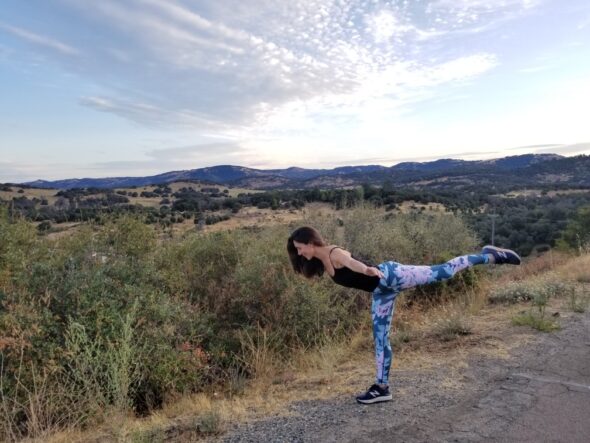
Through contemplative practice I have found we can build our felt sense by developing our capacity to be present with our emotions, sensations, experiences, and the world as it is. Then we can be with our pain rather than being engulfed by it. For example, in a challenging yoga pose we can learn to stay with our feelings, notice our sensations, and stay connected to the strength of our body. Through practice we begin to notice that different feelings, sensations, and thoughts can happen simultaneously. Moreover, we experience that all feelings are finite. The feelings we associate with a difficult pose end when we exit the pose. This is important because when we experience an overwhelming amount of pain, it can feel as if the feelings or sensations that we are experiencing will last forever. It can help to remind ourselves that no experience is permanent, but sometimes it is even more helpful to actually experience this truth in our own bodies. Through practice we develop resilience.
Resilience, like a muscle, can be strengthened through training. It helps us to trust that we will be able to get out of any hole that we fall into, and to build or rebuild our reliable pathway to an experience of inner strength, refuge, and wellbeing.
Join Melissa Lago at one of these upcoming online Drala Mountain programs:
- Mindfulness Meditation and Movement for Wellness with Loden Nyima
- Relax and Renew Yoga Series: Cultivating Peace in Uncertain Times
About the Author
 Melissa Lago, MA, MDiv is a mind-body educator, yoga teacher, and former professor. In addition to yoga, she has taught philosophy, religion, interdisciplinary studies, and the Mind Body Wisdom process. Her primary area of research is on how we cultivate resilience. She holds degrees from Harvard Divinity School, the California Institute of Integral Studies, and Yale University. To learn more about Melissa, please visit her website at www.yogatransformsus.com.