
Feeding your Demons: Revealing the Hidden Treasure Within Difficulty
By Charlotte Rotterdam //
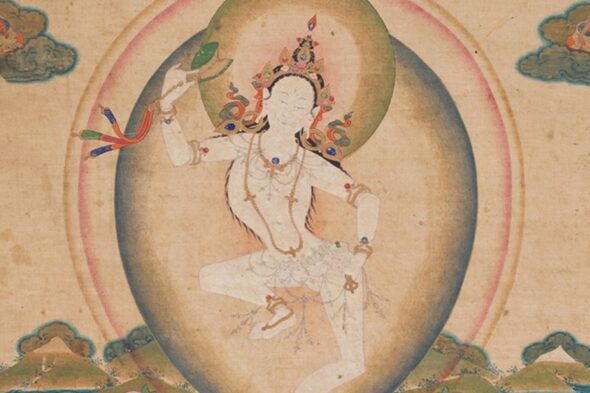
I was first drawn to the Feeding your Demons process and the teachings of Machig Labdrön – the great 11th century Tibetan yogini from whose teachings the process was developed – for the radical invitation to turn towards that which we find most repulsive or frightening. This view seemed so counter-intuitive, so clearly different from the human default response of avoiding or rejecting the ugly and threatening aspects of life. Perhaps it reminded me of my early childhood, when I spent time in the autopsy lab with my mother, a pathologist. There was an odd peacefulness in the autopsy room where the intensely eerie became quite ordinary and sometimes even sacred.
Beyond transforming the morbid into the mundane, however, lies a profound teaching on compassion. Ultimately, these teachings suggest that it is only by meeting and even nurturing whatever we consider threatening or “other” that we can live a fully integrated life, radiant with our own wisdom. Holding our inner and outer demons at bay draws us into a never-ending cycle of avoidance, protection and defense. If we consider our tactics at trying to destroy, ignore or resist our demons, we will realize that these strategies never really free us from our demons. They remain, lurking on the edge of our awareness or stuffed into recesses of our emotional basement.
Demons are anything that keeps us from living our lives fully, anything that inhibits our expression, the fundamental joy of our being. Demons can be fears – failure, loss, disappointment, abandonment. They can be destructive habitual patterns of anger or reactivity, obsessions or addictions. Our insecurities and self-doubt are demons, as are self-criticism and judgment. Sometimes we can locate demons in our physical body in the forms of pain or illness, and our encumbered relationship to these difficult aspects of experience. Sometimes demons arise in the heat of a moment and subside; others are patterns we have developed over a lifetime.
Of course, our default tendency is to try to get rid of these aspects of ourselves and our experience. We fight our demons, attempting to destroy them. Or at least, we repress or hide them so that we don’t need to look them in the eyes. This is a natural instinct, probably based in our evolutionary biology that favored the avoidance of poison as a survival technique. But it’s not so effective when we are dealing with more subtle aspects of our experience. (Interestingly, certain fields of healing intentionally use “poison” as a form of medicine.)
In contrast, to feed our demons means to first acknowledge our demons and then to engage them with compassion and nurturance. The underlying view here is that our demons are aspects of ourselves that have not been fully integrated. Like a small child looking for attention, our demons first tug at our sleeves, then become louder and more aggressive the more we try to ignore them. They have something to tell us that we are unwilling to hear.
When my children were young, I found myself haunted by negative feelings that seemed contrary to what I had expected to encounter in motherhood – frustration, impatience, even dislike for my own child. I wasn’t willing to have the grumpy mother – or “monster mama” as we came to name her – be part of my persona. There was some ideal of the “good mother” that I thought I should live up to. The demon of the “bad mother” knocked more and more loudly on my door until I had to come to the humble realization that I could both love my children and lose my temper or be unkind at times. In acknowledging and bringing compassion to the bad mother within me, I also became more generous and tenderly compassionate to all mothers in the world who struggle in their own way with the journey of parenting.
But what does it mean to “feed” our demons? If we are addicted to smoking, are we feeding the demon of addiction another cigarette? Of course, not. The Feeding your Demons process guides us into an inquiry into both what the demon overtly seems to want – another cigarette – and more subtly, what it really needs. This distinction is critical. Feeding the want seems to temporarily fulfill us, but ultimately, we remain hungry, unsatisfied. The need beneath the want may be a wish for love and intimacy, a sense of self-worth, fulfillment, peace. When we feed the need that lies at the heart of our demon, we bring compassion and kindness to a part of ourselves that has been under-nourished.
Like mythical demons guarding a great treasure, our demons can reveal inner insights and wisdom that have been covered up. The vulnerability and tenderness that often lie at the heart of our demons give rise to profound insight into our own nature and the nature of reality around us. So often we find beneath our demons a wellspring of creativity, a clear awareness of purpose, or vast compassion. By feeding our demons, we allow this brilliance to reveal itself, to find voice. What previously haunted us becomes a source of resilience.

About the Author
 Charlotte Rotterdam teaches Buddhism and meditation in the US and abroad, and was authorized to teach by Lama Tsultrim Allione. She is an Instructor and Director of the Center for the Advancement of Contemplative Education at Naropa University. The mother of two boys, she has published essays on the intersection of spiritual practice and motherhood in Mandala and in an anthology, Fearless Nest. Charlotte received her Masters in Theological Studies from Harvard Divinity School.