Our Bodies Hold Our Lives
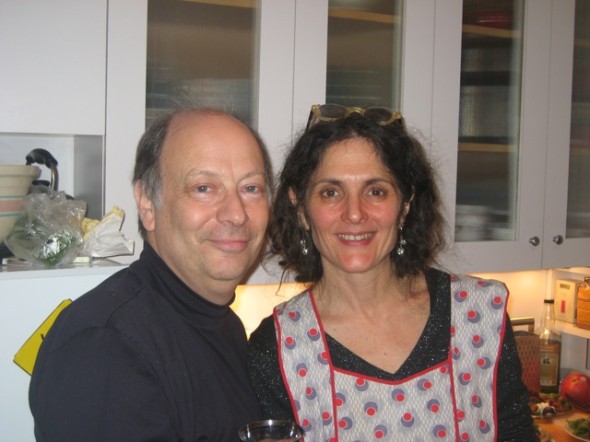
By David Rome & Hope Martin ~~~
Our bodies hold our lives. They hold wisdom and energy for living and growing—and they hold the things that get in the way of living and growing: fear, anxiety, stress and more. When negative holding patterns are not recognized, tensions build up and space for living constricts.
Awareness and acceptance of the body’s holding patterns allow their release and transformation into positive energy for living.
Human beings are hard-wired with the “fight or flight” reaction, an evolutionary inheritance that served us well when the everyday environment was more physically dangerous and instant reaction could make the difference between life or death. In the safer but far more complex world of the twenty-first century, we face multiple challenges that can’t be solved either by fighting or running away. This leads to chronic stress and anxiety and what psychologists call “experiential avoidance”—disconnecting from the fight-or-flight-based signals our bodies are still trying to give us. To reverse the stress and anxiety, first we have to allow ourselves to really experience what’s going on in our bodies at a pre-conceptual, somatic level.
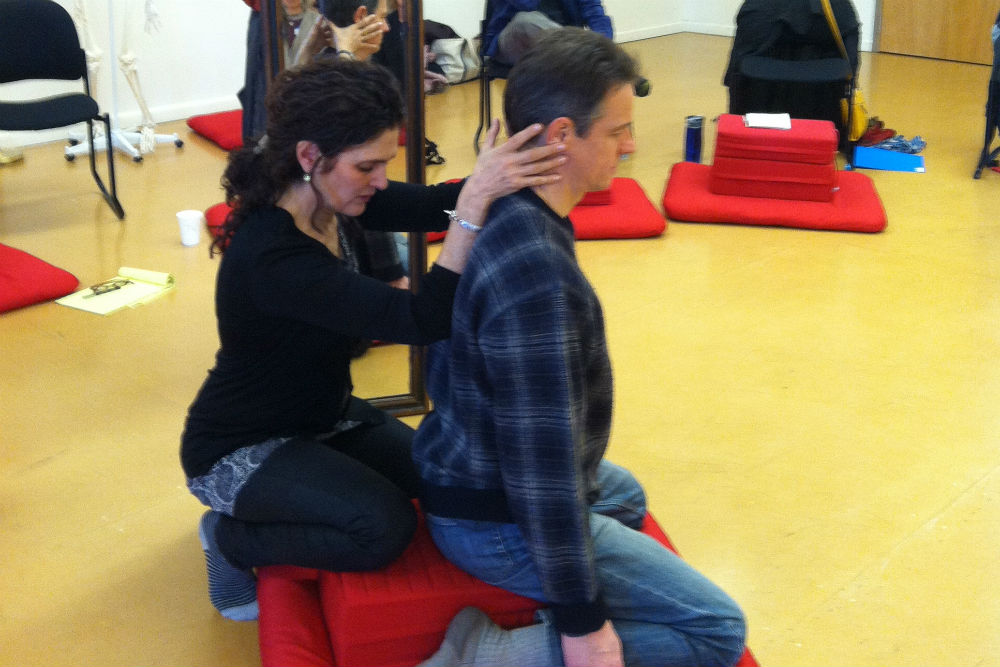
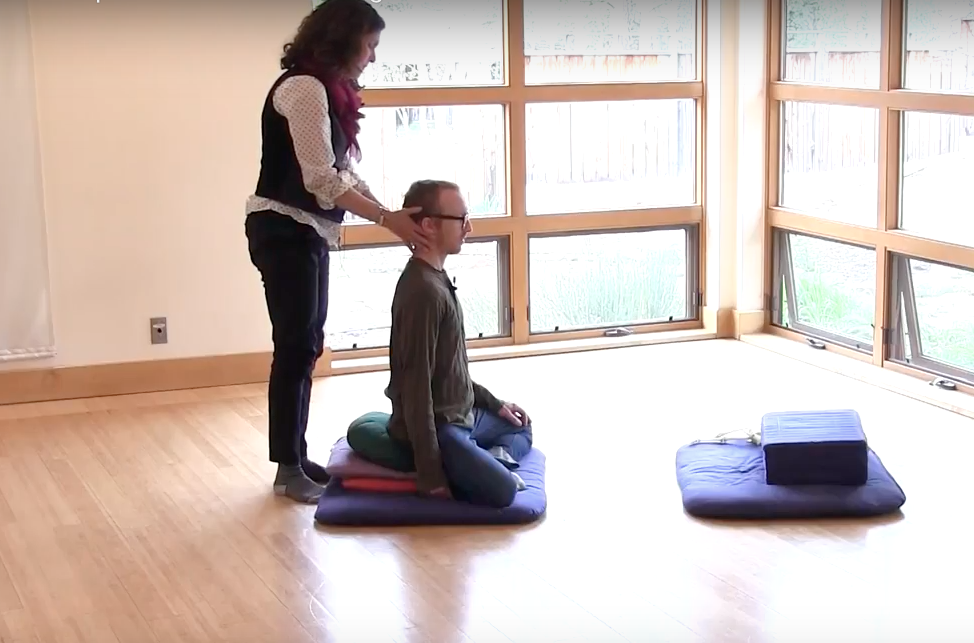
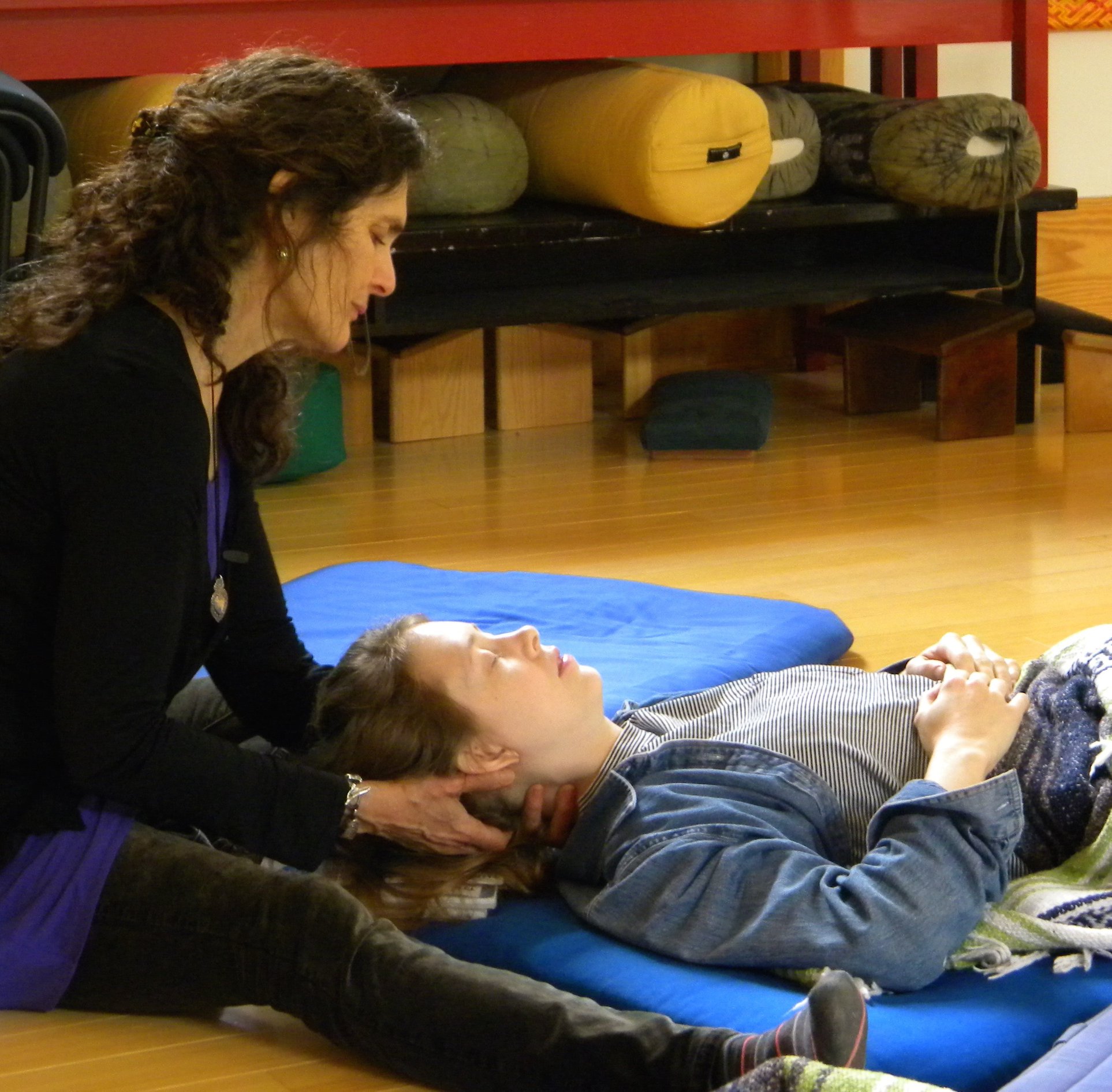
F.M. Alexander, a late 19th century Shakespearean actor in Australia, lost his voice and spent years in painstaking self-observation until he identified unconscious patterns of body-mind tension and developed a method to overcome them. In Embodied Listening, Hope describes Alexander’s template for deep transformational change: becoming aware of the physical pattern but suspending the impulse to correct it and instead getting to really know the pattern with friendly curiosity. Change comes by releasing constriction, having a clear intention and allowing the body to respond from its natural balance. Hope guides students to allow a naturally poised head-neck relationship that the rest of the body responds to by releasing its holding patterns.
David describes philosopher and psychologist Eugene Gendlin’s discovery of the “felt sense,” the unclear, non-conceptual, bodily-felt knowing underlying all of our thoughts and emotions. The felt sense can be accessed using a special kind of gentle, inner-directed intention and attention called Friendly Attending. David leads a guided visualization for cultivating the attitude of Friendly Attending, followed by an exercise using Friendly Attending to begin noticing subtle inner felt senses.
As we cultivate our capacity to recognize and be friendly to our self as someone who suffers, we also learn to recognize and get some distance from the “inner critic,” the part of us that makes negative self-judgments which impair self-confidence and cause us to avoid doing the things we want to do, or feel shame or guilt about things we did do. Through self-empathy we are able to bring to light hidden fears that underlie feelings of self-doubt, frustration and stuckness, and transform them into life-enhancing new insights and behaviors. Judgmental and unfriendly as it can be, the inner critic contains its own form of intelligence and can be a great ally once we learn to make the right relationship with it.
Hope describes “chronic lockdown,” a bodily response that blunts our experience of fear and discomfort and produces a tense, frozen state that diminishes our sense of aliveness. Letting go of this tension means recognizing holding patterns in the body that keep fear, painful experience, and past trauma stuck and unable to move through. Hope guides students in letting the head-neck relationship initiate release of tension through the whole body, resulting in more integration through the torso. An exercise called Downright/Upright is presented in which feeling the support of the ground, together with awareness of the space around one, anchor a “neutral” state in which whatever arises, pleasant or unpleasant, is directly experienced. As tension is released, a sense of natural flow returns to the body and the nervous system becomes more resilient.
As we go about our lives and relationships with others, the key ingredient for not falling into reactive, constricting patterns is pausing and touching in with our present-moment, bodily-felt experience before initiating speech or action. When we spend time with ourselves in this way, our experience becomes less held, less solid and less automatic. Pausing gives us room to open up to a bigger, more spacious perspective from which we can respond rather than react. In the gap between stimulus and response, a wiser and more skillful next step can come. As F.M. Alexander observed, “The right thing does itself.”
Shambhala Mountain Center hosts Trusting the Wisdom of Direct Experience: Embodied Listening® May 29–31, 2020
About the Authors
 Hope Martin has taught the Alexander Technique for 30 years, trains Alexander teachers at the American Center for the Alexander Technique and operates Hope Martin Studio in New York City. She is a Meditation Instructor and a Focusing trainer. Her particular passion is in assisting her students discover how easeful, upright posture is an expression of their human dignity, confidence, and innate wakefulness.
 David I. Rome is the developer of Mindful Focusing, an integration of Eugene Gendlin’s Felt-Sense Focusing and Buddhist mindfulness-awareness practices. He is the author of Your Body Knows the Answer; Using Your Felt Sense to Solve Problems, Effect Change, and Liberate Creativity (Shambhala Publications, 2014). Earlier, David studied Buddhism with Chogyam Trungpa Rinpoche, whom he served as private secretary for many years.