སྒྲོལ་མ་ Drölma – Green Tārā, The Bodhisattva Goddess: Enlightened Feminine Wisdom in Action
By Nashalla G. Nyinda Menpa TMD //
As with most Bodhisattvas, obscure and sometimes contradictory origin stories abound. In one myth, Avalokiteśvara, the great bodhisattva (the literal meaning of his name is “The Lord Who Looks Down”) was observing the innumerable beings suffering in the worldly realm. The Buddha taught The Four Noble Truths, the suffering involved at birth, old age, sickness, and death were endless. The human realm is complex in it’s suffering because even if we try and avoid our pain, we run headlong into it. Beings suffer when there is basic lack of resources and also the lack for what is desired. Likewise burdens arise through actions, situations and objects we never wanted. In short, humanity seeks happiness, but co-creates suffering and only until non-dual wisdom arises within that we live in cycles of unhappiness and wanting out of our pain.
Avalokiteśvara had at this time been steadily working to liberate innumerable beings from the sufferings of existence, yet, still uncountable beings suffered. This realization brought him to tears. As he wept, his tears fell creating a vast lake. From the depths of this lake the epitome of Avalokiteśvara’s compassion grew into a blue utpala (lotus). On this lotus appeared a bodhisattva embodying wisdom and compassion in female form, a young goddess. This was Tārā. So advanced in her wisdom and bodhisattva nature, she is actually considered a fully awakened Buddha.
In Buddhism, female energy is the essence of wisdom, the essence of male energy is action. Tārā embodies the enlightened feminine wisdom in action. To westerners, the female form representing compassion may seem natural. However it should be understood in traditional Buddhist iconography, the tendency is for male form to represent compassion, while a female form more frequently represents wisdom. Tārā in her enlightened wisdom and action together bucks that trend.
Though Buddhism has seen countless enlightened women, a female form typically is seen as disadvantageous for spiritual pursuits compared to a male form. This is taken so seriously in Asian culture that female spiritual aspirants often might pray to be reborn as male for aiding future spiritual endeavors. In a realistic worldly viewpoint, indeed women have, and continue to have obstacles for spiritual opportunities. From access to education, time needed for retreat being hampered by endless responsibility of household and raising offspring; women have not always had the say in what life they will live. Even in modern times, close male monastic friends of mine have said they hope I can be a monk in my next life. This is not limited to Asian patriarchy, rather it’s the inequality female bodied individuals globally face even today. Tārā is the essence of transcending that reality.
However, relevant here to this issue of female form and obstacles to spiritual practice is the second creation myth of Tārā. In ancient times Tārā was said to be a devoted follower of the Buddha’s teachings. Sometimes named as a princess, and sometimes known only by the title Jñānacandrā — meaning ‘Moon of Wisdom.’ So devoted was she, that monks told her they would pray for her to be reborn in male form in order to afford the opportunity to pursue her enlightenment. In sharp wit and wisdom Jñānacandrā pointed out their bias and taught a lesson the true non-dual nature of reality. Jñānacandrā vowed to always take the form of a woman. This intention pointed out the qualities of enlightenment female wisdom in action. The active form of wisdom is compassion, just like that of a mother for all her children. An unbiased and full loving kindness regardless is the action of a true bodhisattva. Indeed, rather than take a traditionally more advantageous form of a male, she said she would continue to manifest in female form with intentions to save and assist all suffering sentient beings.
Her prowess, and non-dual nature of wisdom and compassion caught the attention of Buddha Amoghasiddhi (who’s name literally translates as “He Whose Accomplishment Is Not In Vain.”) Among the Five Wisdom Buddhas of the Vajrayana tradition, he gave her the name Tārā, or “Savioress.” Not surprising, Amoghasiddhi is paired with Tārā, given his power is associated with the accomplishment of the path of awakening and destruction of the poison of envy. Amoghasiddhi and Tārā as spiritual consorts are connected with the element Air, itself associated with their color green.
Historically, there is no record of Tārā before the 5th or 6th century C.E. She seems to have evolved from the early Brahminical goddess Durgā (“Difficult or Narrow Passage”) with whom she shares both names and attributes. According to the Hindu classic, the Mahābhārata, Durgā gets her name because she rescues people from difficult passage. (This version of Durgā is not the same as the later warrior-goddess.)
Her name is derived from the verb meaning “to cross” or “to traverse”. Pali’s verb tarati means “to get to the other side.” This word is cognate with the Latin “trans” (across). The second meaning of Tārā literally means “star,” or “planet,” or “she who ferries across.” Interestingly, the Pole Star, used to guide travelers, was known as Dhruva-Tara or ‘the immovable star.’ As a guide in our practice, we can call upon her as needed. She becomes a focal point in difficult or fearful moments, to guide our lives in a safe and enlightened direction with wisdom and compassion. We can embody her enlightened qualities, taking her as our guide, moment by moment, as we navigate our lives and spiritual obstacles. A third meaning for Tārā is “pupil of the eye.” With the sharp eye watching over the worldly sufferings of endless beings, she is ready to aid with fierce wisdom and compassion. Tārā offers a focal point, like the Pole Star, she assists those who are navigating the waves of samsara through developing our awareness and fearlessness. Like the star she can be a focal point to guide those who seek to reach the shores of liberation.
Important to understand here is the absolute nature of non-dual reality, in which Tara is not “female” and “male” Buddhas and Bodhisattvas are not male. Why is this important? Because fully awakened beings are beyond the limiting conditions of ordinary human consciousness. Thus, they are not defined by gender or bodily form. Mahayana Buddhism understands gender as a psycho-social construct which can be transcended. That is why we see the union of male and female wisdom and action as the ultimate view in Vajrayana. While often misunderstood Tantra literally means “body-protect” and the ultimate actions of we ourselves uniting our inner male and female principles in a wisdom and action state is the ultimate protection against dualistic thinking.
An important Mahayana Sutra, The Vimalakirti Nirdesa illustrates this point*. In this story, Śāriputra, the renowned disciple of the Buddha, whose wisdom is said to be unparalleled, finds himself in conversation with an unnamed goddess that is without question spiritually superior to him in every way.
Śāriputra, like many, remains trapped by dualistic thinking. Assuming that of course her female form is a hindrance, he asks the goddess, “Goddess, what prevents you from transforming yourself out of your female state?”
The goddess replies, “Although I have sought my “female state” for these twelve years, I have not yet found it.” This is pointing to a teaching that the reality of non-dualism, which is the ultimate state of wisdom is demonstrated because the goddess does not see herself as female, nor Śāriputra as a male. Why, she has transcended socio-cultural conditioning, a limited viewpoint and has even gone beyond any biological conditioning or notions of form.
The goddess then seriously messes with Śāriputra with her magical power, she transforms herself into his form, while transforming him into a female. Then she says, “Śāriputra, what prevents you from transforming yourself out of your female state?”
Śāriputra, quite surprised to be transformed replies, “I no longer appear in the form of a male! My form has changed into the form of a woman! I do not know what to transform!”
The goddess said then, “If you, Śāriputra can transform out of the female state — then so too, all women can transform their female states. Women appear in the form of women, just as you now appear as such. While reality is devoid of form, they appear in form.”
Then, she again used her magical power to returned him to his ordinary male form. She then says, “Śāriputra, what have you done with your female form?” This passage illustrates what it is meant when the Buddha said, ‘In all things, there is neither male nor female.’
Tārā indeed is praised for her practicality. Swift to aid in anyone in troubled times on the bodily, mental or emotional level of our ordinary suffering. With a foot extended down she is ready to leap into action and give aid. While her power to assist in times of fear and deep trouble is unparalleled, the most vital aspect to her wisdom and action is her protective powers to those who call upon her with faith and devotion to learn how to save themselves. This is accomplished through following her teachings and by development in a path to liberation of relative suffering! When one works to develop a bodhisattva point of view — fear and dualistic thinking diminishes, and with it the three root poisons loosen their grasp upon our lives and actions. Suffering naturally diminishes.
The first Dalai Lama described Tārā as a protectress against demons. Those demons are in some cases self-generated by our overthinking, attachments and aversions and any spiritual doubts which can become all-consuming.
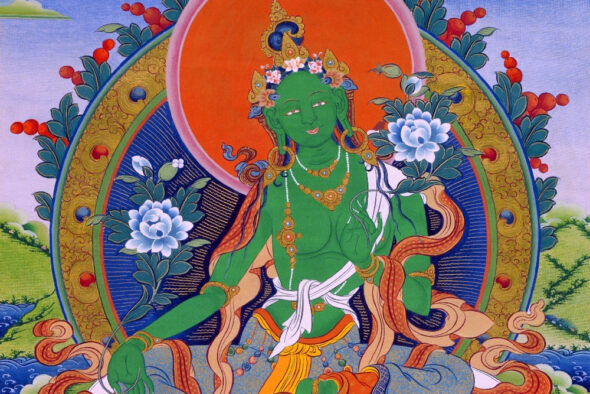
The core significance of the utpala lotus flower is that it remains unstained, even in very contaminated environments. As a night-blooming flower, the utpala lotus she holds represents Tārā protecting in the dark of night, at times of our greatest fears. This represents both literal darkness and the darkness of ignorance.
Tārā is one of the most popular Buddhist deities in the Mahayana world, and among the most popular deities within Tibet. Her mantra is second only to Avalokiteśvara. Her left hand is in the mudra, or gesture of giving. Tārā makes herself available to the world when practical needs and spiritual needs both require assistance. Her generosity is boundless.
Her right hand is in the mudra or symbol of teaching. Tārā is teaching us to liberate ourselves and others from the relative or worldly sufferings. Even those of disease, as these too can be purified. I have experience seeing the practice of Tārā as a Tibetan physician work with the relative truth of suffering and disease very swiftly.
However, on a more ultimate level, the actual disease we must unlearn to uncover our basic goodness is our root poison of ignorance. This poison creates duality and self cherishing. By liberating us from this disease, she actually liberates us from the true cause of all suffering and illness, our ignorance.
Due to lacking the realization and interconnected nature of phenomena, or not knowing the absolute nature of reality, we suffer physically, emotionally and mentally. When we exist in duality, all our disturbing thoughts and sensations are fostered from the root cause of suffering, our ignorance, and it becomes a felt experience.
Tārā herself is an advanced Bodhisattva, whose life and purpose is devoted to helping others. In this practice we are taking full refuge in Tārā to uncover our dualistic thinking.
In devotion to establishment of ground and path, through Tārā’s simple practice, you receive the blessings of Tārā in your own heart, which is to say you receive them in your mind. This is because your mind resides in your heart. Therefore, this simple yet profound practice provides encouragement, fortitude and actual real time space to establish your path of embodying full compassion. It encourages development of your own feminine wisdom and action to arise, regardless of the gender form you are residing in and aids to stabilize your mind during any situations of suffering.
Green Tārā short mantra: “I prostrate to the Liberator, Mother of all the Victorious Ones.”
Om Tārā Tu-tare Ture Soha. ༄།། ཨོ་ཏཱ་རེ་ཏུ་ཏྟཱ་རེ་ཏུ་རེ་སྭཱ་ཧཱ་

Footnote:
*Thurman, Robert (1976). VIMALAKIRTI NIRDESA SUTRA. Retrieved from https:// www2.kenyon.edu/Depts/
About the Author
 Nashalla Gwyn Nyinda TMD, LMT began the study of Tibetan Medicine in 1999 and started treating with permission in 2004. She was then encouraged by her teacher, VV Thrangu Rinpoche, to complete her medical studies continuing in India. Nashalla earned her Menpa degree (Doctor of Tibetan Medicine) from Qinghai Tibetan Medical College, Tibet and The Shang Shung Institute of Tibetan Medicine in 2009. She has an Interdisciplinary Studies BA from Naropa University, with a focus on Asian Medicines and Buddhist Psychology. She has taught these techniques worldwide to Tibetan and western students, practitioners, and doctors, and is an Adjunct Professor at Naropa. Nashalla and husband, Dr. Tsundu S. Nyinda, operate the Tibetan Medicine & Holistic Healing Clinic in Boulder, Colorado.